


I’m lucky enough to be employed at a place that does a winter shutdown for the week of Christmas. This is relevant because I was able to turn to my wife this past weekend and ask if she would be willing to accompany me to a showing of The Seed of the Sacred Fig on Monday, December 23, at 11:15am. It was the last showing of this film the theater had. She asked what it was. I told her it was a 3-hour Iranian political thriller. She hadn’t even seen the trailer, and told me yes, she’d go with me.
Yes, she loves me a lot. Too much, maybe. I was worried that she’d be bored out of her mind midway through the film, if not much earlier. (This isn’t an indictment on my wife’s attention span, but an acknowledgment that I am often invested in terribly boring, long-form media.) She insisted she wouldn’t do that–she was committed.
After walking out of the theatre, I was delighted to hear that she felt that the film was among the top films she had ever seen. I felt the same way.
The Seed of the Sacred Fig was written and directed by Mohammad Rasoulof, an Iranian director who had previously directed Manuscripts Don’t Burn (2013) and There Is No Evil (2020). Rasoulof had to flee from Iran to Europe on foot just two weeks before the global premiere of The Seed of the Sacred Fig at the 2024 Cannes Festival, as he was told that he received an 8-year prison sentence for his previous activism and creative work.
It goes without saying that Rasoulof is a fierce critic of the Iranian government. He was previously incarcerated in 2022, and got the idea for this film while he was talking to one of the prison guards:
“While incarcerated, [Rasoulof] followed the “Woman, Life, Freedom” protests taking place in Iran. He then had a discussion with a staff member in the prison, which sparked his interest.
“I had a few words that I could exchange with this man who was in charge of the authority of our prison, and then he told me that he had this feeling of shame and self-hatred that made him even consider hanging himself, killing himself, especially because of the pressure he felt from his children who would not accept that he made a living this way and didn’t accept the role that he took in this repression while people of his generation were protesting on the streets,” Rasoulof reveals.”
Davidson, Denton. Defiance in filmmaking: Mohammad Rasoulof on the secret production and global acclaim of ‘The Seed of the Sacred Fig’. Gold Derby. 20 Dec 2024. https://www.goldderby.com/article/2024/mohammad-rasoulof-the-seed-of-the-sacred-fig-interview/
In September 2022, mass protests began to take place in Iran following the death of Mahsa Amini, a 22-year old who died while in the custody of the morality police. The police claim that Amini was wearing her hijab incorrectly, which led to her arrest. She was subsequently transferred to the hospital and died after having a heart attack, according to the police. However, a CT scan showed bleeding in her brain and skull fractures consistent with being hit on the head. It was suspected that Amini was beaten to death by the police. Thousands of women proceeded to take off their hijabs and protested in the streets, which would kick off a period of civil unrest that lasted for several months.
The civil unrest was said to be the “most widespread revolt” since the Islamic Revolution in 1979. Nearly 20,000 people were arrested in connection with the protests. It is estimated that over 500 people were killed, including 68 minors, and that nearly 900 people were injured.
The Seed of the Sacred Fig feels like it is half documentary, as it included many clips from social media of protestors in the streets, often beaten or killed by Iranian police. Clips also showed police indiscriminately beating or firing on civilians and smashing the windows of passing cars. The clips are essential in creating the political context of the film, and conveying the extreme bias of the state-run media that often depicted protestors as agitators that “deserved” their injuries.
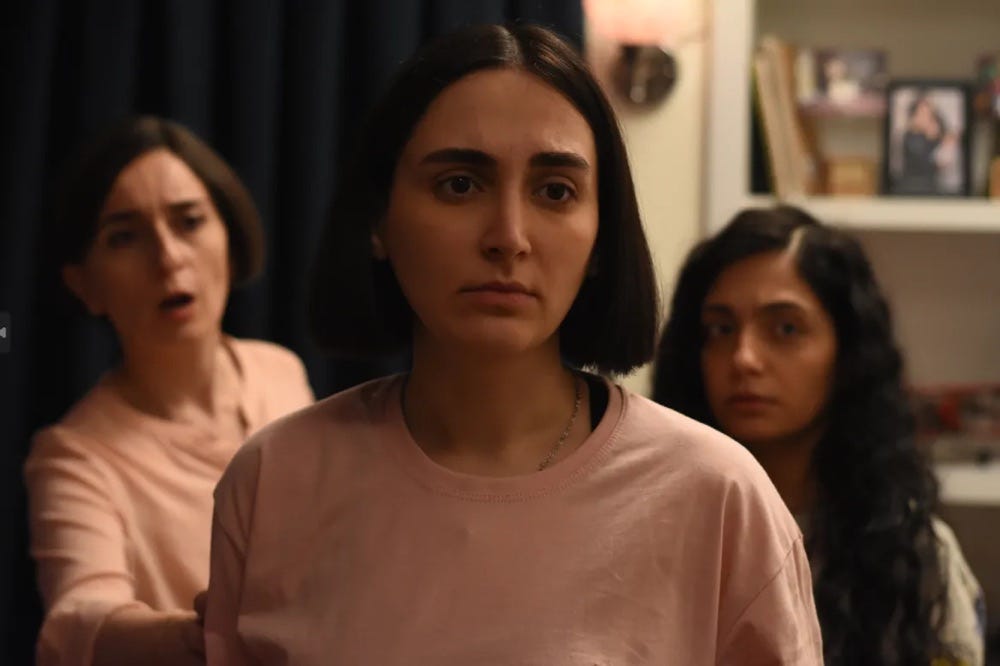
This clashing of realities is also depicted along generational lines in the family central to the film. Najmeh is the mother of two daughters, Rezvan and Sana, both of whom have come of age. Rezvan is a 21 year-old college student while Sana appears to still be in secondary school. Najmeh is married to Iman, who has just gotten a promotion to be an investigating judge on behalf of the government.
The Seed of the Sacred Fig initially tricks the audience into believing that the film would be following Iman and the ins and outs of his government job. This film was billed as a political thriller; where else could the action be? The first few scenes open with Iman at his place of work, a government building filled with life-size cardboard printouts of Iranian political and military leaders. After a few minutes, Iman leaves work and the real setting of the film is revealed: his family home.
In the first two acts of the film, Iman is truly a side character who is rarely at home. All we often see is an exhausted man who returns late in the evening to sleep, with some moral dilemma weighing on him. The meat of the drama occurs between Najmeh and her daughters in their two-bedroom apartment. Najmeh is an incredibly faithful wife who is hopeful Iman’s government job will ensure their family future prosperity. Her daughters are slowly radicalized by the civil unrest. Iman is still regarded with respect and affection by his family, but Najmeh goes out of her way to shield Iman from the issues that arise at home, refusing to exhaust him further.
I have yet to experience a film that has regarded the domestic sphere traditionally assigned to women–cooking, cleaning, and child-rearing–with just as much respect as a traditional workplace. Every emotion experienced by the female characters is taken seriously by the film. The family home quickly becomes a microcosm of what is happening outside on the streets of Tehran, and as a leftist, this was deeply satisfying; it effectively conveys that the personal is political. The way women are regarded in Iranian society, their roles, their expectations, would inevitably have an effect on their family dynamic at home. This film demonstrated that skillfully.
It may be difficult to believe that this film can hold the audience’s interest for nearly three hours, with the majority of it happening between a few family members in a small apartment. But for anyone that’s experienced genuine, prolonged conflict in their families–and I would imagine that is virtually everyone reading this–you know full well that the tension can last for days at a time, if not weeks.
At one inflection point, Rezvan, the eldest daughter, lashes out at her father and accuses him of being an insider that is blind to the abuses being carried out by the government. The next morning, the government-issued gun assigned to Iman disappears from his bedside drawer. It drives him into an intense paranoia that affects the entire family. I won’t comment on who took the gun, as it is a spoiler that is best revealed by watching the film, but I found the gun to be a brilliant symbol for authority. It did not feel like an accident that the gun disappeared from Iman’s possession after being confronted by Rezvan (read: he lost political authority in the family unit), or that he goes nearly insane trying to find it and regain ownership.
In the opening scenes of the film, Iman gingerly offers the gun to Najmeh. Najmeh initially declines to touch it but then briefly holds it when encouraged by Iman. After identifying the gun to be a symbol of (masculine) authority, I found it touching that Iman offered it to Najmeh. Their relationship appeared to be rather tender and equitable on the surface, and I found the depiction sweet. As the political divide between Iman and Najmeh and their daughters grows, however, their marriage is also challenged, and it becomes clear what the balance of power really is.
Over the course of the film, I felt particularly endeared to Najmeh. She was depicted as a faithful wife, a protective and caring mother, and an Iranian woman sensitive to the chaos and suffering all around her. (My wife identified her to be the backbone of the family, tending to the needs of both her daughters and her husband.) Despite holding conservative political beliefs, she still grapples with the assertions made by her daughters, and goes out of her way to protect them or intervene when she is able. It’s not often that a film like this goes out of its way to develop the mother’s character, leaving Iman relatively one-dimensional in comparison. His absence and lack of participation in the political discourse at home felt intentional, and another reason why his authority as the patriarch was fading.
The entire film was made in secret, as producing it openly would have led to the arrest of the film crew. Rasoulof directed the film remotely, which is unbelievable to me. The actors’ performances are incredible. Unfortunately, as a result of the release of the film, many members of the production have had to flee Iran or are currently facing prosecution. If possible, when you watch this film, please watch it through legitimate channels to support the production team.
Regrettably, it does not appear that theatres in the US are screening The Seed of the Sacred Fig any longer. However, it appears to be available to watch on Apple+ TV, which offers a 7-day free trial. If you have a VPN and an Amazon Prime subscription, you may be able to watch on the international catalog of Amazon Prime (it does not appear to be available in the American catalog, unfortunately). I will update whenever there is an official method to purchase the film.
The Seed of the Sacred Fig was such an unexpected treat. I’d be eager to support the director in future endeavors. As of late, I’ve been really interested in learning more about geopolitics in the Middle East. For an excellent podcast series on the Iraq War, I really recommend Blowback (Season 1), which is available on Spotify. As for some high-quality analysis on the fall of the Assad regime in Syria, please check out this episode of the Bad Faith podcast featuring Rania Kalek from Breakthrough News. She does an excellent job breaking down all the regional players in Syria and demystifying how things progressed to this point.
Sources | Further Reading
Chang, Justin. Shot in secret, 'The Seed of the Sacred Fig' calls out Iran's authoritarian regime. NPR. 11 Dec 2024. https://www.npr.org/2024/12/11/nx-s1-5223531/the-seed-of-the-sacred-fig-review-iran
Davidson, Denton. Defiance in filmmaking: Mohammad Rasoulof on the secret production and global acclaim of ‘The Seed of the Sacred Fig’. Gold Derby. 20 Dec 2024. https://www.goldderby.com/article/2024/mohammad-rasoulof-the-seed-of-the-sacred-fig-interview/
Wintour, Patrick, et al. Head of Iran’s morality police reportedly suspended amid protests. The Guardian. 19 Sep 2022. https://www.theguardian.com/world/2022/sep/19/mahsa-amini-iran-protests-enter-third-day-after-kurdish-womans-death-in-custody
Moaveni, Azadeh. The Protests Inside Iran’s Girls’ Schools. The New Yorker. 07 Aug 2023. https://www.newyorker.com/magazine/2023/08/14/the-protests-inside-irans-girls-schools
Iran hangs two men accused of killing security agent during protests. Reuters. 07 Jan 2023. https://www.reuters.com/world/middle-east/iran-hangs-two-men-alleged-crimes-committed-during-protests-judiciary-2023-01-07/
One Year Protest Report: At Least 551 Killed and 22 Suspicious Deaths. Iran Human Rights. 15 Sep 23. https://iranhr.net/en/articles/6200/
Hengaw Report No. 7 on the Kurdistan protests, 18 dead and 898 injured. HENGAW Organization for Human Rights. 26 Sep 2022. https://hengaw.net/en/news/archive/56611